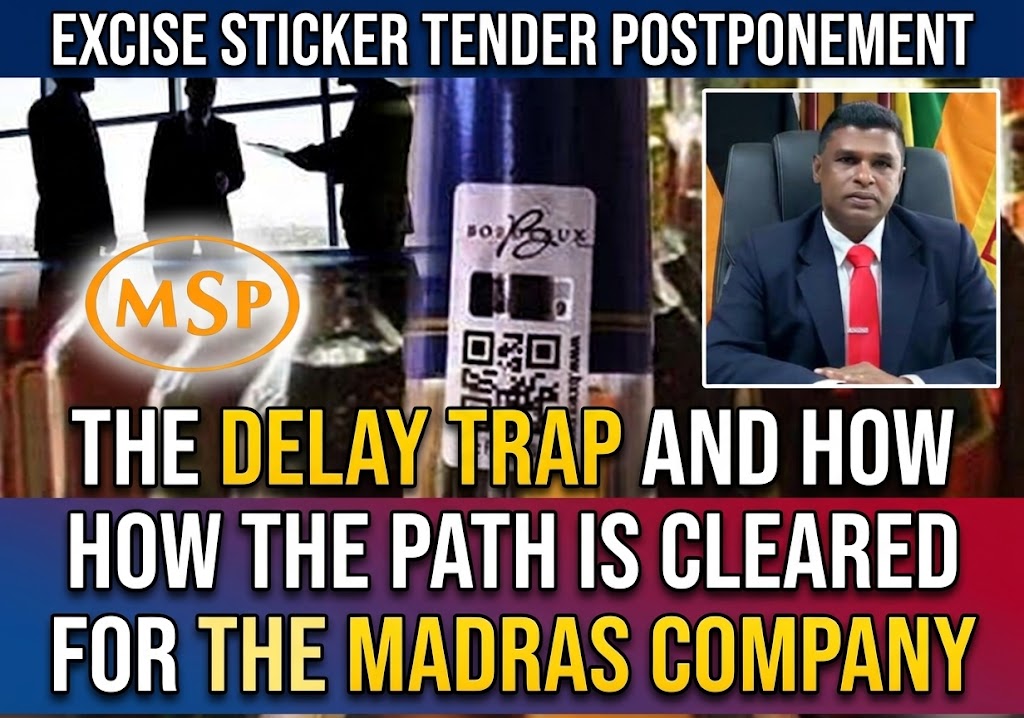
Postponement of the Excise Sticker Tender
The international procurement process for the supply of Secure Foil Stamps and
Forensic Management Systems (SFSFMS) for liquor bottles under the Excise Department was scheduled to conclude on August 31st. However, at the eleventh hour, authorities took steps to extend the deadline for accepting bids by another 22 days, pushing it to September 22nd.
Responding to an inquiry made by the Sri Lanka Mirror today, Excise Commissioner (Retired Commodore of the Sri Lanka Navy) M. B. N. A. Premaratne stated that this postponement was granted following a request made by an "institution" to the procurement committee. However, against the backdrop of the incumbent sticker supplier—India's Madras Security Printers (MSP)—whose contract is set to expire on January 2, 2027, serious suspicions arise. Is this extension merely a simple administrative decision, or is it a covert strategy to renew the contract of the current supplier, who is already facing severe allegations of corruption?
According to government procurement guidelines, a tender deadline can only be extended on highly justifiable grounds, such as significant alterations to technical specifications, the need for additional time to clarify issues raised during pre-bid meetings, or to enhance competition. Given this, what is this "invisible institution" that made a request powerful enough to influence the procurement committee? Was it a request from a competing company, or does it serve the motives of a party that directly benefits from delaying the process?
Although the Excise Commissioner informed the Sri Lanka Mirror that further details could not be disclosed while the procurement process is ongoing, authorities must immediately reveal to the nation who initiated this request, especially concerning a massive international tender that directly impacts state tax revenue.
This suspicion is further intensified by the serious allegations repeatedly leveled against the current supplier, Madras Security Printers (MSP), in recent times. Recently, over 18,000 counterfeit liquor bottles were seized from a secret, illegal distillery operating in the Malabe area of Kaduwela. Investigations revealed that the security stickers affixed to these bottles were imported from India and were so meticulously forged that they could not even be detected by the Excise Department’s own machines. Since the absolute ownership and the authority to print these stickers lie solely with the contracted company and the Excise Department, emerging information suggests the involvement of a powerful former minister and certain excise officials behind this racket.
In light of this grave situation, the parliamentary Committee on Public Accounts (COPA) and the Committee on Ways and Means strongly recommended to the Ministry of Finance and the Excise Department that the current contract be terminated prior to its expiration. However, citing the risk of the government having to pay massive compensation for a unilateral termination, alongside the potential for illegal liquor production to surge in the absence of an immediate alternative supplier, the Ministry of Finance opted to maintain the current company’s services until January 2027.
Against this backdrop, while the 22-day delay in the new tender—which received cabinet approval in May 2026—may seem like a negligible number, it creates a severe bottleneck within the procurement calendar.
Under the new schedule, establishing a new process before January 2, 2027, becomes highly challenging due to several practical constraints. Once the tender closes, the Technical and Financial Evaluation Committees will require months to properly assess the bids. Following this, a mandatory appeals period must be provided to the bidders.
Furthermore, since this project has been operating on a BOO (Build, Own, and Operate) basis since 2016, all the machinery currently in the manufacturing plants belongs to the incumbent company. If a new company is selected, a transition period of at least three to six months will be necessary to install new machinery and upgrade the systems.
Factoring in the time required for all these steps, there is a high probability that the 22-day delay will render the initiation of the sticker printing process through a new tenderer by January 2, 2027, entirely impossible. If a new supplier cannot be secured by the deadline, the government will face a massive financial crisis; if sticker printing halts, excise revenue will completely collapse. The inevitable next step is glaringly obvious. Citing the severe risk of essential services and tax revenue collapsing, and claiming there is no viable alternative, the procurement committee will be legally compelled to extend the contract of the current service provider for another year or an additional period.
Therefore, society must seriously question whether postponing the tender scheduled to end on August 31st was genuinely based on an institutional request, or if it is a calculated "Bureaucratic Trap" designed to kill time and hand the contract right back to the incumbent holder. Operating under the guise of securing government tax revenue, this procurement distortion—driven by delaying tactics—must be rectified immediately with absolute transparency.
#NiromiSubramaniam
Right to Reply
As a responsible media organization, we strictly uphold the "Right to Reply". If you or your organization are mentioned in any of our articles and wish to express an objection, share a different perspective, or provide a factual clarification, you have the right to do so. We are committed to fair and balanced journalism.
Please submit your responses or clarifications to:
[This email address is being protected from spambots. You need JavaScript enabled to view it. / whatsapp 0774945996]
Editor's mail - This email address is being protected from spambots. You need JavaScript enabled to view it.