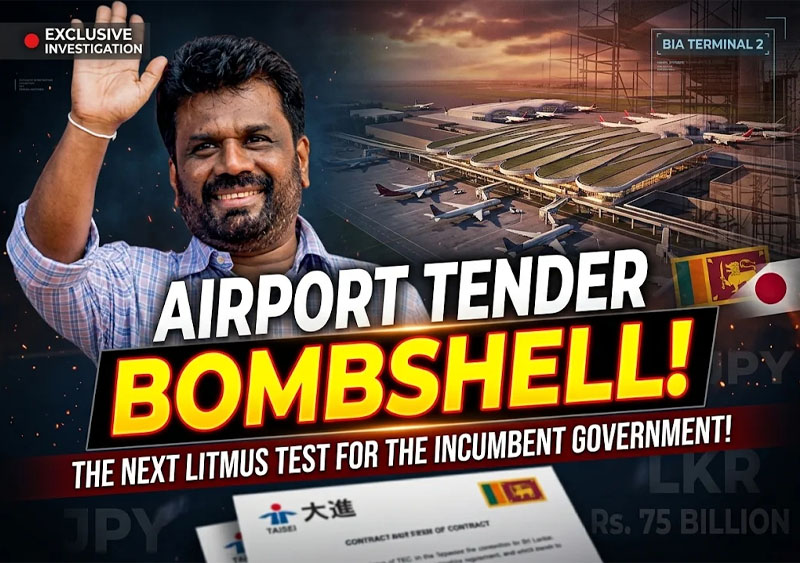
A potentially explosive financial scandal surrounding the Bandaranaike
International Airport (BIA) Terminal 2 construction project has now come to light. The exposure of such national crimes relies on the unwavering belief that the incumbent government will take decisive and appropriate corrective action.
Elected on a powerful mandate to eradicate corruption and the misuse of public funds, the new administration now faces a genuine litmus test: will it allow the deeply entrenched, corrupt procurement networks of the past to survive, or will it uphold its promises?
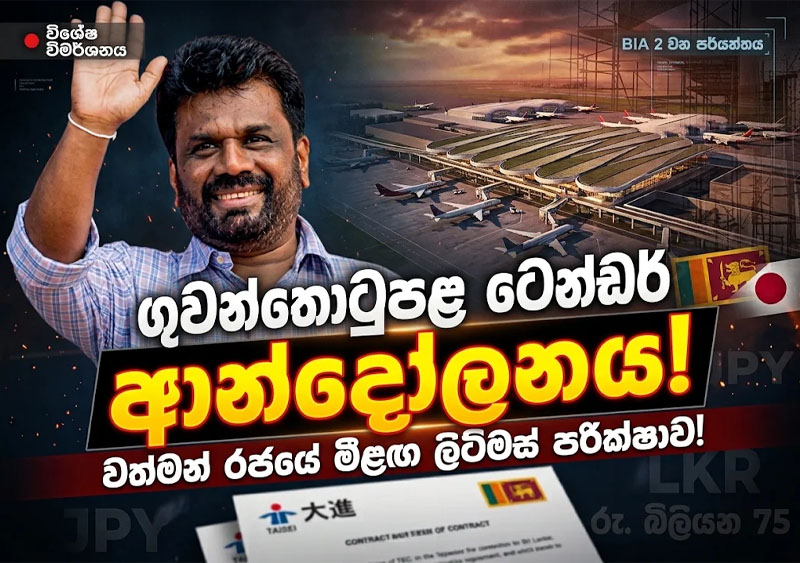
The roots of this crisis date back to 2020, when the construction contract was initially awarded to Japan’s Taisei Corporation. The project subsequently stalled in the wake of Sri Lanka's economic collapse and the suspension of JICA funding. When fresh tenders were called in September 2024, bids were submitted by both Taisei Corporation and the Sojitz–L&T consortium.
In a startling turn of events, however, Sojitz–L&T was eliminated from the race after being declared technically non-responsive. Despite the Technical Evaluation Committee (TEC) arguing with JICA for over a year that Sojitz–L&T was a credible bidder, Taisei was ultimately left as the sole technically qualified competitor. The most alarming aspect of this development is that the rejected competing bid was reportedly about USD 250 million cheaper than Taisei’s original offer.
Having emerged as the sole bidder, Taisei has initiated a price hike that can only be described as unjustifiable daylight robbery. Their original bid of JPY 105 billion has now been inflated to JPY 131 billion—an extraordinary 24.76% escalation in roughly two years. According to global construction inflation indices, a reasonable escalation for the 2025–2026 period is only around 9%, which would place the maximum justifiable price at JPY 114.45 billion. Yet, the contractor is demanding an additional JPY 16.55 billion without any demonstrated, index-based justification.
Factoring in exchange-rate fluctuations, the project's indicative rupee cost skyrockets from Rs. 200 billion to Rs. 275 billion. This exorbitant Rs. 75 billion increase—approximately USD 226 million—represents a staggering 37.6% surge. To put this into perspective, building the entire Mattala Airport cost only USD 209 million. Committing an additional USD 226 million merely for an extra terminal, under the guise of project delays, would be a catastrophic waste of public funds. Furthermore, when factoring in the USD 190 million additional premium currently demanded by the company, the total gap between the rejected lower bid and Taisei's proposed revised price widens to an astronomical USD 440 million.
Even more deeply troubling is the alleged administrative interference driving this highly unreasonable escalation. Serious accusations have surfaced that the Secretary of the Ministry responsible for the airport is acting favorably toward Taisei Corporation, vigorously pushing to push through the approval of this USD 190 million hike. At a time when six members of the TEC have reportedly refused to endorse this proposed increase, the Secretary’s alleged attempts to override their independent technical evaluation signify a severe breakdown in procurement governance. Taisei's argument that costs have risen due to the Middle East conflict is equally flimsy, given concerns that their original price was already inflated by over 30%, making the geopolitical excuse entirely disproportionate to the amount sought.
While it is undeniably true that Sri Lanka desperately needs a new airport terminal, it must not be built at any price. The government, led by President Anura Kumara Dissanayake, must intervene decisively to immediately suspend this highly suspicious price escalation. It is imperative to urgently review the objections raised by the TEC members and launch a comprehensive investigation into the undue interference by the Ministry Secretary.
To save hundreds of millions of dollars, the government must urgently assess, in consultation with JICA, whether a properly structured rebidding process could secure substantial savings—even if it necessitates a further three-month delay. Failing that, maximum pressure must be applied on Taisei Corporation to strictly adhere to its originally quoted price; if they refuse, their bid bond should be confiscated, and they should be shown the door. The time has come for the President to prove his anti-corruption mandate through decisive action to safeguard the public purse. The entire nation is watching.