The Sri Lankan government’s endeavors—and the President's subsequent directives—
to regulate online gambling appear to have culminated in an absolute failure. Although the proposed Gambling Regulatory Authority Act envisioned bringing all land-based and online gambling operations under a unified regulatory umbrella, the ground reality remains starkly contradictory. The primary catalysts for this regulatory collapse can be analyzed as follows.
The Licensing Paradox and Double Standards
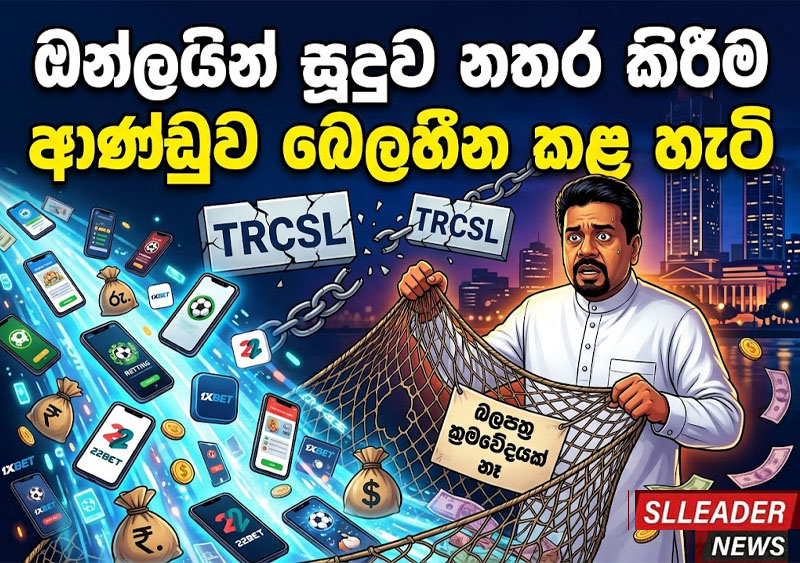
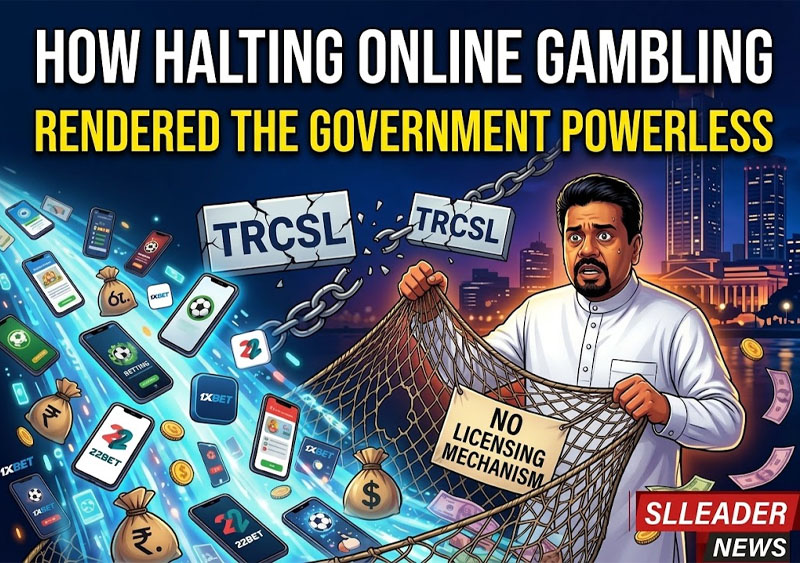
As an initial deterrent against online gambling, the Telecommunications Regulatory Commission of Sri Lanka (TRCSL) blocked 146 international gambling websites, citing their "unlicensed" status within the country. However, the profound irony lies in the fact that Sri Lanka has yet to establish any legal mechanism to issue licenses for online gambling.
As Sudaraka Ariyaratne, a researcher at the Advocata Institute, highlights, banning entities in a landscape devoid of a licensing framework presents a severe legal and ethical dilemma. Adding to this paradox, the government has permitted local land-based casino operators (such as Bellagio and Bally’s) to continue their online operations unhindered, relying solely on the premise that they are "registered companies." These local online gambling networks, which emerged during the COVID-19 pandemic, operate equally "without licenses" under the current law. Consequently, the state’s law enforcement exhibits a blatant double standard.
Technological Futility and Surrogate Advertising
The TRCSL's approach to blocking websites has proven to be a technical fiasco. According to investigations conducted by social media researcher Dr. Sanjana Hattotuwa, banned platforms like 1xBet have effortlessly circumvented state barriers utilizing dynamic domain technology. This is further corroborated by the fact that the number of banned URLs accessible via the SLT and Dialog networks approximately doubled between August and September.
Furthermore, these international conglomerates actively exploit "surrogate advertising" loopholes to aggressively market their brands. Operating under the guise of a sports news portal named "1xBAT," 1xBet managed to secure approximately 9% of screen time during the Lanka Premier League (LPL) and the Sri Lanka-India Test series broadcasts. The deafening silence of law enforcement and regulatory agencies in the face of such brazen violations remains a matter of grave concern.
Economic Hemorrhage and National Security Threats
In an effort to meet International Monetary Fund (IMF) revenue targets, the government increased taxes on land-based casinos from 15% to 18% and doubled their entry levies. Yet, the crux of the issue is completely ignored: 60% to 70% of Sri Lanka's entire gambling market comprises online platforms that pay absolutely zero taxes. With an estimated 300,000 individuals engaging in online betting, an astronomical amount of potential state tax revenue is being siphoned overseas due to this regulatory vacuum.
Moreover, the unchecked proliferation of online gambling poses a direct threat to national security. Since these transactions bypass the formal banking sector—relying heavily on Undiyal, Hawala, and cryptocurrencies—the ecosystem has morphed into a safe haven for money laundering. Sri Lanka is slated for a rigorous assessment by the Financial Action Task Force (FATF) in 2026. Failing to rein in this unregulated financial flow places the country at an imminent risk of being relegated back to the FATF "Grey List."
Administrative Bottlenecks and Political Vulnerability
The administrative paralysis driving this crisis is rooted in the fact that relevant regulations have been languishing within the Attorney General's Department for 15 months. Furthermore, these legal drafts are being formulated with zero consultation from industry experts. Additionally, as pointed out by the Advocata Institute, the proposed Gambling Regulatory Authority severely lacks structural independence. Placing the authority under the absolute purview of the Minister of Finance creates a significant risk: rather than functioning as an impartial, corruption-free entity, it is highly susceptible to becoming a tool driven by political agendas.
The Way Forward
To effectively navigate this crisis, Singapore’s Gambling Control Act of 2022 serves as a formidable benchmark. Unlike Sri Lankan law, which currently does not penalize the gambling 'consumer,' Singaporean legislation imposes a $10,000 fine and imprisonment on individuals participating in illicit gambling. This strict liability acts as a potent psychological deterrent, effectively isolating consumers from illegal betting networks.
Furthermore, instead of relying on the futile exercise of domain blocking, Sri Lankan regulatory bodies must be empowered with direct statutory authority to intercept and block the flow of funds to illegal gambling platforms via the formal banking and financial sector, mirroring Singapore's jurisdiction.
For the President's directive to materialize into tangible results, the government must transcend superficial website bans. It is imperative to urgently enact a technology-driven, independent regulatory framework, institute a transparent licensing mechanism, and enforce stringent financial blocking statutes. Failing to do so will ensure that the pledge to halt online gambling remains nothing more than a hollow political slogan.
#NiromiSubramaniyam